


Liminality
- Oct 10, 2019
- 3 min read
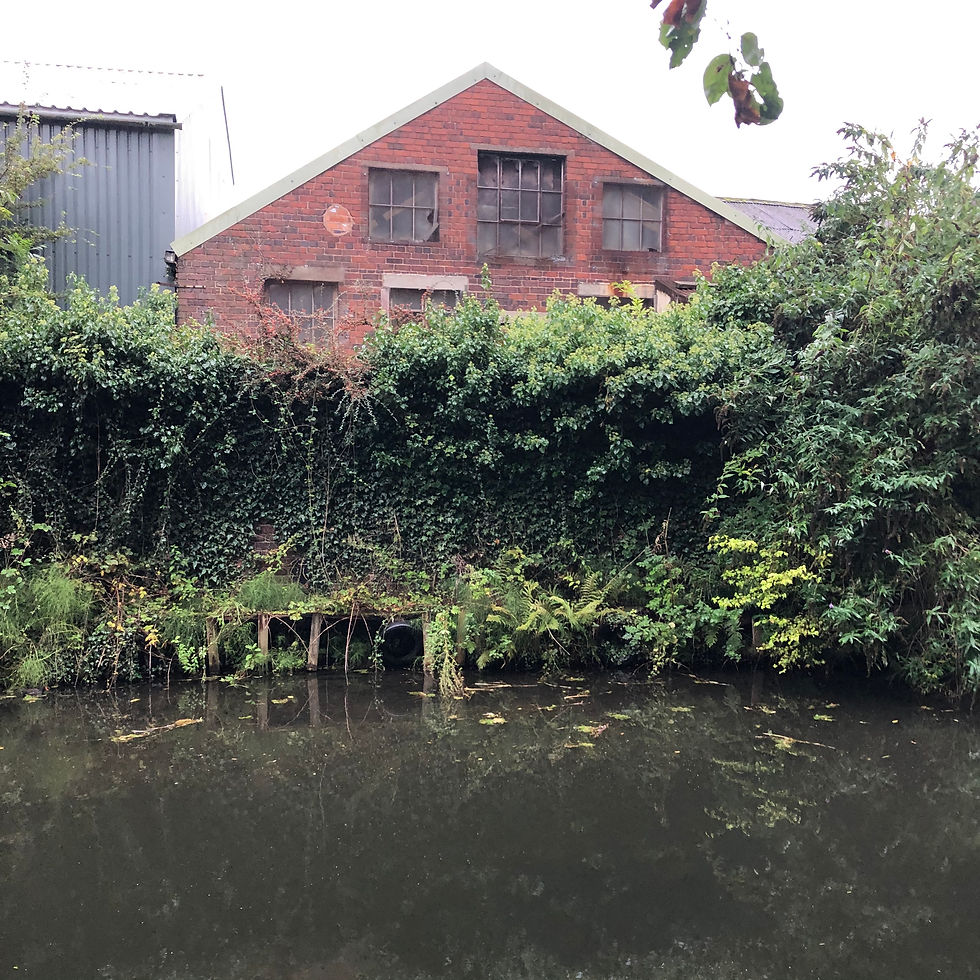
Liminal is a cool word these days. It seems to sum up a kind of middle ground occupied by what might otherwise have been known as neutrality, transitional or perhaps even dull. It's the grey area. Rob Francis calls the Black Country 'a place difficult to map, a place where new meets old, where rural life sits next to heavy industry, a place geographically and socio-politically liminal.' (Francis, 2018, p.4)
I've been reading Mike Bunn's Reading Like a Writer, most of which, as my old Dad would say, is stating the bleedin' obvious, but in the article, amongst other things, Bunn talks about how writer Wendy Bishop changed her reading process when she wanted to 'become' a writer. He says: 'Bishop moved from simply reporting her personal reactions to the things she read to attempting to uncover how the author led her (and other readers) to have those reactions.' (p.73) Bishop says, 'I started asking, how—how did the writer get me to feel, how did the writer say something so that it remains in my memory when many other things too easily fall out.' (p.73). Bunn goes on to liken the way in which an architect or a builder might look at a house in order to learn how to put a house together, whether or how the various techniques - the building blocks - work to create the building. As someone who has written novels and short stories, I'm often surprised when readers and reviewers, start talking about whether they like a particular character I've written, or, worse, start some kind of psychoanalysis on these characters. I have often said - reminded, that is - readers and reviewers that my characters are not real. It's fiction. Reading like a reader, it seems to me, assumes a kind of reality that doesn't exist. Adjusting thinking to reading like a writer, according to Bunn, involves looking at the mechanics of a piece and deciding whether or not you, as a writer, want to use that technique. This morning, walking, I was thinking about writing with the Black Country in mind, and particularly with God's Country in mind. And I think what reading Bunn's piece clarified to me was that I am writing it so that those who choose to 'read it like a writer' begin to see the techniques I am using and will explore what those effects have on them. I hope that, like Bishop, they will look underneath the plot and look for how the writing gets them to feel this sensation of the Black Country. Walking today, I was trying to pinpoint how my writing exemplifies this Black Country 'liminality' In the past, glibly, I know, I've called the grammatical technique I use 'a quirk', some people have given it a fancy grammatical term (some reviewers have, a bit rudely I think, called it 'a gimmick'. It is not.) I need to think about this more, of course - I need to write and read my work like a writer - but, look: 'She will say...' 'She might say...' 'She would have you think...' 'She won't tell you this but...' 'she would have you believe...' I realise now these a phrases are examples, in and of themselves, of liminality, aren't they? They're phrases on the threshold of meaning. A state of liminality is one where the order of things has been suspended. It is an unsettling place to be. Through this liminality of sentence construction (and I'm going to start calling it that), I am exemplifying the borderlessness of the (so called) place in which the plot is set.
Francis, R. 'Queering the Black Country: A Critical and Creative Response.' PhD thesis 2018 https://wlv.openrepository.com/handle/2436/622334 [ACCESSED 15th September, 2019)
Bunn, Mike, ‘How to Read Like a Writer’, in Writing Spaces: Readings on Writing, Volume 2, 2010 http://writingspaces.org/sites/default/files/bunn--how-to-read.pdf [ACCESSED 10th October, 2019]
Comments